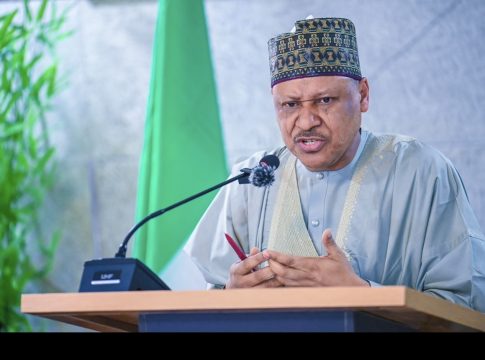
ECOWAS COURT OF JUSTICE OFFICIALS

The presentation, marks a major step in strengthening regional justice delivery, promoting human rights, and upholding the rule of law.
Key Priorities
The plan sets out key priorities, including improving judicial efficiency, expanding access to justice for citizens, enhancing regional legal harmonisation, boosting institutional capacity, and deepening transparency and stakeholder engagement.
Tagged “Justice 2030,” the initiative underscores ‘the court’s resolve to build on past gains and effectively address the evolving justice needs of the sub-region.’
Firm Commitment
Speaking at the unveiling, the Court’s President, Ricardo Goncalves, described the plan as a firm commitment to institutional transformation, efficiency, and meaningful impact on citizens’ lives.
Goncalves said that it reflects a shared determination to strengthen the court’s role as a guardian of the rule of law, a promoter of justice, and a key pillar of regional integration.
“This moment is not merely symbolic. Above all, it represents a turning point. It is a clear affirmation of our collective resolve to strengthen the role of the Court as a guarantor of the rule of law, a promoter of justice, and a vital pillar of regional integration in West Africa,” he said.
Goncalves, however, noted that no plan, however well designed, can be realised without coordinated action, institutional discipline, and a strong sense of individual responsibility.
He said that to realise such objectives, the court’s judges, staff members and other stakeholders must all work in synergy.
“The Judges of this Court are the guardians of its integrity and credibility. They are called upon, not only to decide with independence and rigour, but also to lead by example”.
More importantly, justices are expected to reinforce the quality of jurisprudence, promote consistency in decisions, and contribute to a system of justice that is accessible, expeditious, and respected. He stated
In his words, “Judicial leadership must be proactive, strategic, and responsive to regional realities”.
Backbone of ECOWAS Institution
Goncalves described the court’s staff as the backbone of the institution, noting that administrative efficiency, effective case management, technical rigour, and strong service culture were indispensable to the plan’s success.
“Every department, every division, every unit, and every staff member has a direct role to play in achieving the strategic objectives. Institutional excellence is built daily through discipline, innovation, and a commitment to results.
He warned that the old way of working, mechanically repeating the same tasks, often making the same mistakes, and offering the same excuses, must, quite frankly, become a thing of the past.
Soliciting For Support
Goncalves solicited the support of stakeholders, including Member States, ECOWAS institutions, legal networks, development partners, and civil society, to make the plan successful, stressing that the court does not operate in isolation.
“Its relevance depends on the active collaboration of these actors in the enforcement of decisions, legal harmonisation, capacity building, and the promotion of a culture of legality and accountability,” he said.
Goncalves called for effective planning to achieve success under the new dispensation, noting that without effective planning, there can be no consistent execution, and without consistent execution, there can be no real transformation.
“We are entering a new phase, one in which the court must be more visible, more accessible, more efficient, and more influential.
Ushering a New Chapter
The ECOWAS Court President stated that today, the regional judicial arm, is not merely launching a Plan, we are ushering in a new chapter in the advancement of the ECOWAS Court of Justice as a leading institution, serving community justice, stability, and regional integration.
Read More : Regional Integration Projects Ends ECOWAS Golden Jubilee
The ECOWAS Court of Justice is an organ of the Economic Community of West African States, (ECOWAS), a regional integration community of 15 member states in Western Africa. It was created pursuant to the provisions of Articles 6 and 15 of the Revised Treaty of the Economic Community of West African States (ECOWAS).
Economic Community of West African States (ECOWAS)
Source: PR ECOWAS/ VON
About the Author