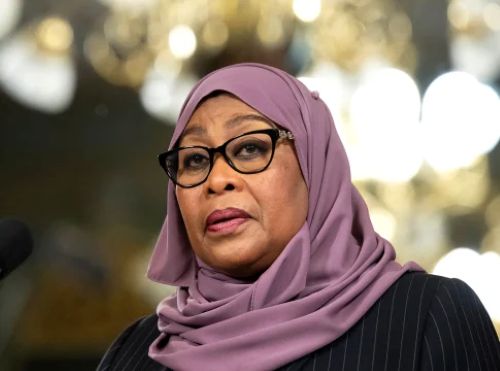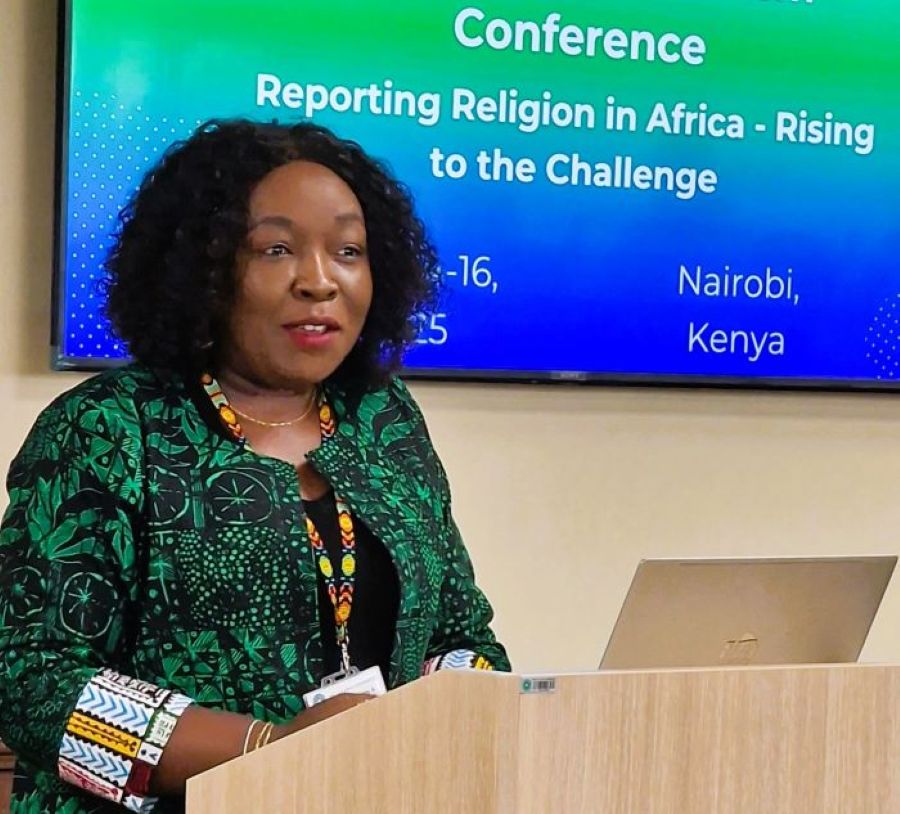
Professor Nancy Booker, AGA khan University
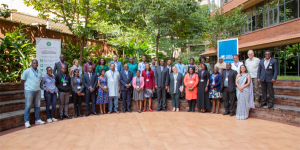
This was Despite its profound impact on values, politics, and identities across Africa, religion remains one of the most underreported and misunderstood beats in journalism.
Coverage is often limited to events rather than deep, investigative reporting — a consequence of limited funding, lack of institutional support, and the marginalization of religion journalism in many newsrooms.
These concerns were echoed by experts at the opening day of a three-day conference and workshop hosted by the International Association of Religion Journalists (IARJ), in collaboration with the Aga Khan University’s Graduate School of Media and Communications (GSMC) and KAS Media Africa (Konrad-Adenauer-Stiftung).
In the words of Professor Nancy Booker, Dean at GSMC:
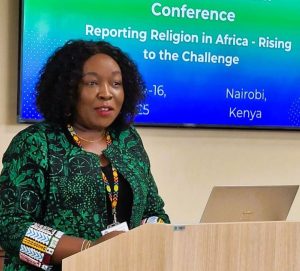
“ Driven more by personal commitment than institutional support, coverage tends to focus on events rather than deeper analysis,” . “To better serve audiences, religion should be reported with the same depth and seriousness as other major beats—offering context, respect, and critical insight into its role in public life. Religion is a subject that is as sensitive as it is powerful and as complex as the societies we report on.”
Equipping Journalists
The event aims to strengthen religion reporting across the continent by equipping journalists with the tools, context, and confidence to cover religion with the same depth and seriousness as politics, health, or economics.
The keynote speaker, Dr Andrew Kaufa, Coordinator of the department of Social Communications of the Association of Member Episcopal Conferences in Eastern Africa (AMECEA) called on learning institutions to train today’s communicators to uphold professionalism while remaining sensitive to Africa’s rich religious diversity.
“As storytelling increasingly shifts to social media, communicators have a responsibility to promote inclusivity, amplify diverse voices, and reflect a wide range of religious perspectives” .
“At the same time, governments and media houses should invest in media literacy to help the public better detect bias, misinformation, and disinformation.
Strengthening partnerships between media and religious communities is also essential to fostering mutual understanding and respect.”
Hendrik Sittig, Director Media Programme Sub-Saharan Africa from Konrad Adenauer Stiftung (KAS) stated that the political misuse of religion fuels division and conflict, often serving as a tool for power.
“Religion is often instrumentalized to achieve political goals and secure power.”
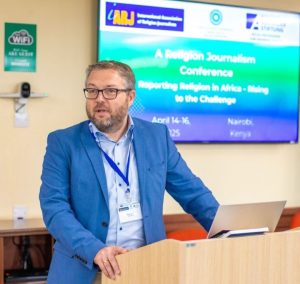
At the same time, Sittig addressed the issue of disinformation, highlighting how disinformation—amplified by Artificial Intelligence (AI)—has become a powerful weapon in hybrid warfare. “It spreads faster, appears more credible, and deeply threatens democracy by dividing and polarizing society,” he stated.
More Collaborations
Prince Charles Dickson, a founding member of the International Association of Religion Journalists (IARJ) called for collaboration among journalists.
“In a world where division often dominates the headlines, we—as journalists from diverse faiths and backgrounds—have a unique opportunity to model collaboration”.
“I invite you to make this conference a space where our differences are not only tolerated but truly celebrated, where questions are met with curiosity rather than judgment. Together, let’s learn from one another and build something meaningful.”
Key Observations
- Imbalanced Reporting: Media coverage often lacks depth, perpetuating stereotypes or political agendas due to insufficient religious literacy and editorial biases.
- Politicization of Religion: Sensationalism and oversimplification in reporting risk exacerbating interfaith tensions or legitimizing extremist narratives.
- Gender Disparities: Women remain underrepresented in both religious leadership and newsrooms, limiting diverse perspectives in coverage.
- Youth Engagement: Young voices are critical to interfaith dialogue but are marginalized in media spaces.
- Conflict and Peacebuilding: Religion’s dual role in fuelling conflict and fostering reconciliation is often underreported.
- Digital Challenges: Misinformation thrives online, yet digital platforms also offer untapped potential for constructive discourse.
Recommendations
- Strengthen Ethical and Contextual Reporting
Develop Africa-centric guidelines for religion reporting, emphasizing accuracy, cultural sensitivity, and conflict-aware journalism.
Train journalists in religious literacy, including workshops on Africa’s diverse faith traditions and their socio-political contexts.
- Combat Extremism and Promote Peace
Avoid sensationalizing extremist acts; instead, amplify narratives of interfaith solidarity and grassroots peacebuilders.
Collaborate with cybersecurity experts to counter online radicalization while protecting free expression.
- Advance Gender Equity
Newsrooms should adopt policies ensuring gender parity in staffing and coverage, including stories on women’s roles in religious spaces.
Support networks for female journalists specializing in religion reporting.
- Engage Youth and Interfaith Dialogue
Create platforms (e.g., podcasts, youth-led panels) for young Africans to discuss faith, media, and social cohesion.
Partner with educational institutions to integrate media literacy and interfaith studies into curricula.
- Foster Collaboration and Policy Advocacy
Establish forums for regular dialogue between media, religious institutions, and policymakers to address mutual concerns.
Advocate for legal frameworks protecting journalists covering sensitive religious issues and ensuring access to information.
-
Leverage Digital Innovation
Utilize fact-checking initiatives and social media campaigns to disseminate balanced religious content.
Invest in digital storytelling tools to highlight underrepresented voices, such as indigenous faiths and minority communities.
-
Monitor Progress and Accountability
Form a continental working group to track implementation of these recommendations and publish annual progress reports.
Host regional follow-up conferences to share best practices and address emerging challenges.
Conclusion
Religion reporting in Africa holds the power to either deepen divides or bridge communities. This communique calls on all stakeholders—media houses, religious bodies, governments, and civil society—to commit to ethical, inclusive, and courageous journalism. By centering accuracy, empathy, and collaboration, we can transform religion reporting into a force for unity, understanding, and sustainable peace.
Read More : https://www.aku.edu/about/Pages/home.aspx
https://theiarj.org/news/way-forward-for-religion-reporting-in-africa-impressions-and-suggestions/
Source – International Association of Religion Journalists (IARJ newsletter
About the Author

Qasim Akinreti
Editor
A Multimedia International Journalist with Voice of Nigeria. Author, Media Trainer, and Consultant. Head Digital Media Department Voice of Nigeria