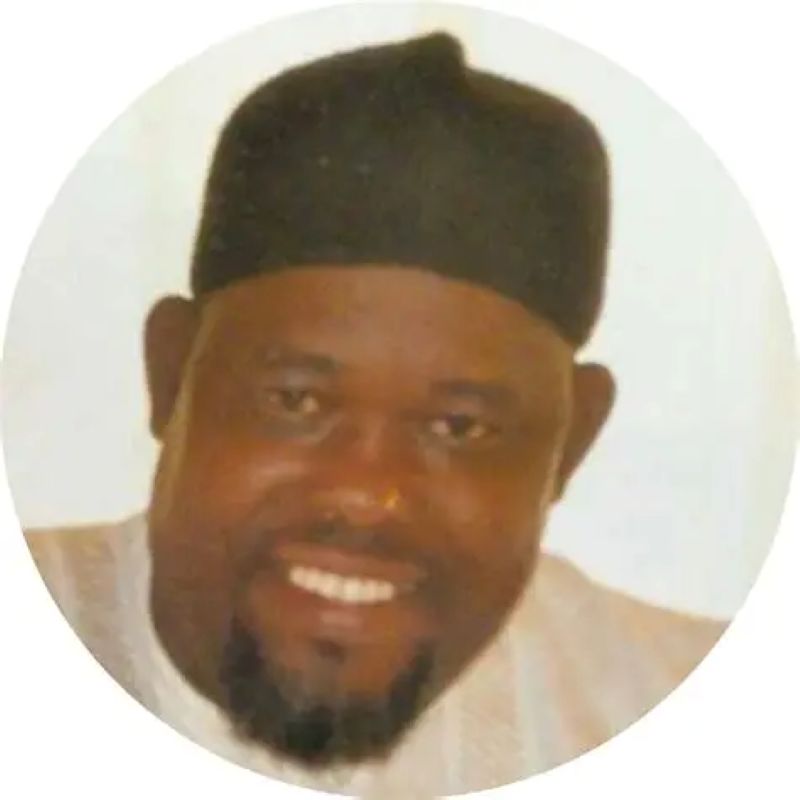
Professor Saheed Timeyin

Hurray, it’s the month of his birth again! The month that welcomed Allah’s greatest light into this world. The month that opened the heart of humanity to the attainment of perfect moral and spiritual maturity. The month that witnessed the birth of Muhammad, the final bearer of divine legislation – the month of Rabee’ ul Awwal.
The Prophet (saw) was not just a person. He was a phenomenon. One of the remarkable features of his blessed personality is the balance between humanity and divine commissioning. He was human. He never claimed divinity, yet he was the conduit of the Divine Intention on earth.
The Qur’an says:
“Say: I am only a human being like you, to whom it has been revealed…”
Qur’an 18:110
Like us all, he ate, slept, married, experienced grief, became tired, tool ill, got wounded, and shed tears. Yet, this ordinary human life was unique. His uniqueness was not that he ceased to be human, but that he demonstrated how humanity could reach its highest moral and spiritual potential.
Everything about him carried the signs and symbols of a miracle. Yet, his greatest miracle was not merely an event – it was a book that bestowed on mankind the greatest civilization.
When we speak of the miracles of the Prophet (saw), we often mention the splitting of the moon. But among the most overlooked signs is what happened through his character and message. The miracle of transforming individuals into a community, tribes into a brotherhood, enemies into companions, slaves into respected members of society, an oral culture into a civilization of knowledge, and scattered people into a community with a moral mission.
The Qur’an captures this transformation:
“…and you were on the brink of a pit of Fire, and He saved you from it.”
— Qur’an 3:103
His moral excellence was so outstanding that even his enemies became the most powerful witnesses to his character. This is a particularly fascinating dimension. Before his prophetic mission, he was known among his people as: As-Saadiq Al Ameen – the truthful and trustworthy.
Even many of those who opposed his message could not successfully accuse him of being a liar before his mission. When Heraclius, the byzantine emperor questioned Abū Sufyān about the Prophet, he asked whether they had ever known him to tell a lie before his claim to prophethood. Abū Sufyān acknowledged that they had not.
This gives us an important and powerful principle: the credibility of the Messenger preceded the message. He conquered hearts before territories.
Military history often describes the Prophet (saw) through battles and political expansion. But that can obscure something much deeper. His most remarkable victories were moral victories.
He stood before people who had persecuted him and his followers; those who had expelled him and fought against him, and those who had killed and maimed many of his lovers at the time of the conquest of Makkah. He did not turn victory into a festival of revenge. He did reenact the gory pictures of gruesome massacres victors often reveled in. He declared: “You are all free. There shall be neither reproach nor vengeance against you”.
This is one reason his conquest remains morally distinctive. He demonstrated that power is most beautiful when it is restrained by mercy, and his mercy extended even to those who rejected and persecuted him.
Allah describes him:
“We have not sent you except as a mercy to the worlds.” Qur’an 21:107
Note that the Qur’an does not say “mercy to Muslims.” It says: “to the worlds”; to the universe as a whole.
His mercy encompassed human beings, animals, children, the poor, servants, prisoners, and even those who opposed him. His greatest concern was not his own legacy but the salvation of others. This is something deeply moving about him. He was repeatedly concerned about people who rejected him. Allah told him:
“Perhaps you would consume yourself with grief that they are not believers.” Qur’an 26:3
He was not merely trying to win an argument. He wanted to unite the people with their Creator.
His personality was a delicious blend of apparently opposite qualities, yet beautifully combined. His uniqueness can be seen in the extraordinary balance of his personality. He was simultaneously strong, but gentle, powerful, but humble, a statesman, but accessible to ordinary people. He was a warrior who wielded the sword of mercy, a loving husband, but a caring leader of a nation, a spiritual teacher, but deeply practical, a devout worshipper, but actively engaged with society, and a visionary, but attentive to small details. This balance is one of the most complex dimensions of his Sunnah to reproduce.
He did not merely preach equality – he embodied it.
Bilal was an Abyssinian former slave. Suhayb was Roman. Salman was Persian. The companions came from different tribes, classes, and backgrounds. Yet, the Prophet created a community in which faith and righteousness, rather than race, wealth, or tribal pedigree, became the basis of honour.
The Qur’an later expressed the principle:
“Indeed, the most honoured of you in the sight of Allah is the most God-conscious of you.” Qur’an 49:13
One strange dimension of his greatness was how he treated people whom powerful societies often overlook. He sat with the poor. He visited the sick. He attended funerals. He listened to people. He greeted children. He helped his family. He repaired things in his home. He served himself.
His greatness did not create distance between him and the most lowly members of the society.
The greater he became in the eyes of heaven, the more humble he remained among people.
His leadership survived because he built people, not dependence. Perhaps one of his greatest leadership secrets was that he did not create a community that could function only in his physical presence.
He trained: Abū Bakr, ʿUmar, ʿUthmān, ʿAlī, Khālid, Muʿādh, ʿĀ’ishah,
Umm Salamah,
Ibn ʿAbbās, Ibn Masʿūd,
and hundreds of others.
He developed human capacity. That is why his mission continued after his death.
His household, too, became a school of prophetic knowledge. The role of his wives, especially ʿĀ’ishah, was very notable. The Prophet (saw) did not merely teach publicly. His home became an intimate laboratory of prophetic character, worship, family life, and ethics. His wives transmitted knowledge that could never have been learned from public sermons alone.
This means that understanding Muhammad (saw) requires studying him as an atlas of all human experiences. We are therefore challenged to reflect on Muhammad, the Messenger, Muhammad, the husband, Muhammad, the father, Muhammad, the ruler, etc. All these with an understanding that whatever our positions, there is always a model for us in the Prophet.
His relationship with Allah was the hidden engine of his public greatness. The world saw the Prophet (saw) as a leader. But before he was a leader of people, he was a servant of Allah.
Allah instructed him:
“Stand in prayer during the night, except for a little.” Qur’an 73:2
His public strength was rooted in private worship.
This may be one of the most important lessons for contemporary Muslims: visible impact is sustained by invisible devotion. He cried for people who did not know that he was crying for them. The prophetic concern for humanity was extraordinarily deep.
He prayed for his Ummah, worried about them, and repeatedly sought Allah’s mercy for them. His concern extended beyond his immediate generation.
To love him is not merely to praise him; it is to inherit his concern for humanity. His final sermon was remarkably universal
Near the end of his earthly mission, he addressed matters that remain profoundly relevant: human dignity,
sanctity of life and property, family responsibilities, treatment of women,
prohibition of exploitation, equality,
brotherhood, accountability before Allah. His message was not merely for 7th century Arabia. It articulated principles with enduring relevance.
Perhaps the deepest uniqueness: he changed people who then changed the world.
Muhammad (saw) did not leave behind: a palace, an empire,
a personal fortune, statues, monuments, or a dynasty. He left behind human beings. People who had been transformed by him went on to transform others.
Fourteen centuries later, his name continues to be pronounced millions of times every day in the Shahādah, Ṣalāh, Adhān and Ṣalawāt. That is a different kind of legacy.
He came into a world that did not know what it needed and left behind a generation that knew what it was living for.
The uniqueness of the Prophet (saw) is not exhausted by the miracles that happened around him; it is revealed in the person he was, the people he transformed, the principles he taught, the brotherhood he established, the mercy he embodied, and the civilization he inspired.
It is perhaps pertinent to conclude with a declaration made by several generations of historians and hagiographers:
“Humanity has known no man whose followers loved him, whose life they studied, whose words they preserved, whose character they sought to emulate, upon whom they invoke blessings, and whose name they remember every day, like Muhammad (saw).”
May Allah count us among his worthy followers who uphold his Sunnah and propagate his ideals in thoughts, speech, and action.
Professor Timehin Saheed Olurotimi, writes the Lagos state University, LASU.
About the Author