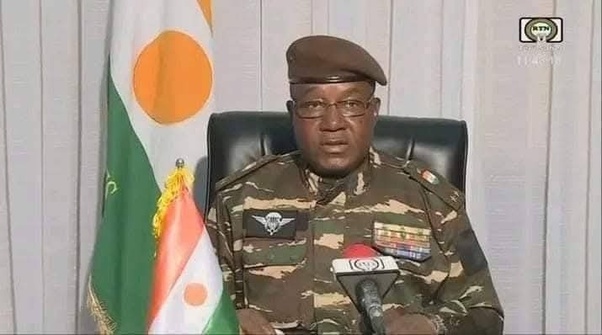
Mali Head Of state
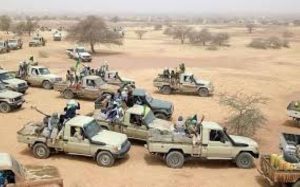
Perhaps, it was the most ambitious, direct strike at the Malian state in more than a decade.
On April 25, armed elements of the Touareg separatist Azawad Liberation Front (FLA) and Jama’at Nusrat al-Islam wal-Muslimin (JNIM) carried out coordinated attacks in northern Mali and, in a suicide bombing, assassinated Sadio Camara, the defence minister, his spouse and an indeterminate other member of his family.
Camara was the one who negotiated the Russo-Mali defence pact through which Russian troops were invited to boost Bamako’s security architecture.
The shocking, devastating sanguinary development has cast a pall of distress and mourning throughout the country, but within the military, embarrassment.
The Kidal onslaught was shocking for its claim of the life of Camara. It was devastating because it exposed the shallowness of security and defence intelligence gathering by the military regime that came to power in 2020 via a coup and vowed a sustained pacification of the restless separatist Touaregs and the al-Qaeda-allied JNIM that seem to control the extreme, dusty north of country.
JNIM was reported, in 2020, by Wikipedia, as “the fastest growing militant organizations in the world. As of 2025, it was considered the most heavily armed militant group in the Sahel and one of the most powerful globally.
The group operates a decentralized proto-state model in areas under its control, enforcing a strict interpretation of Islamic law and collecting taxes. “Its influence is presently expanding southward to coastal West African countries, including Benin and Togo.”
President Assimi Goïta has assumed the post of defence minister.
The Kidal attack has also posted, in relief, the extreme extent that FLA and JNIM are set to reach in their bent to have an independent state of theirs in northern Mali, about which they have been – in some instances – by occasional dislocation of economic activities, via rampage and banditry, shortly before Mali’s independence from France in the late 1960s.
The shock that Kidal is would widely be felt because it was least expected that with the presence of Russian military advisers and mercenaries that the Goïta regime had invited, soon after the expulsion of French troops, to help boost Mali security and blunt insurgency in the north.
The flip side of the argument is that, in spite of Moscow’s dash to Bamako’s security needs, the crisis in Mali’s is scorched north – to the southern fringes of the Sahara – the insurgency there is a typical asymmetrical warfare that, for too long, has robbed the Malian military of decisive victory.
The soaring challenge of the FLA and JNIM tends to question just how sound a decision it was when Goita regime pulled out of the Economic Community of Western African States.
Recall that Mali, Burkina Faso and Niger, all neighbours in the Sahel, withdrew from the Economic Community of West African States (ECOWAS) on January 29, 2025, “after the military juntas rejected demands to restore democratic rule.”
All three countries are currently members of “the Alliance of Sahel States (AES), accusing ECOWAS of foreign influence, failing to combat terrorism, and imposing harsh sanctions.”
It’s the position of some analysts that Mali’s defence experience would not have been dented by the forced exit of Camara were she still with ECOWAS, which would have brought to bear its peace-keeping experience in Liberia, under the ECOWAS Monitoring Group (ECOMOG).
Still, Bamako’s choice of Russian troops was, in part, informed by Moscow’s silencing of Chechen separatists in the Caucasus in the opening years of the 21st century.
She expelled their French sires in August 2022, who were part of Operation Barkhane, for strained ties and the expulsion of the French ambassador.
The exit of French troops from Mali – alongside neighbouring Burkina Faso and Niger – has diminished Paris’ influence in the Sahel.
The position of ECOWAS on the emergence of juntas in Mali, Burkina Faso and Niger was that it had no quarters – especially in the 21st century – for coup-borne military governments that stifle the growth of democracy and sustainable human development.
The assassination of Camara is a calculated jab by the FLA and JNIM to weaken the morale of the Malian military. It was a daring, seismic push to offend, with telling effects, what Bamako has held, with confidence, as its settled tectonic turf. Camara’s death means a new height; a notch in the profiles of the FLA, JNIM. It is in the character of insurgents, a la FLA and JNIM, to hit at top state operatives, in the considered expectation to force their opponents to the negotiating table for peace talks in the course of which they would be offered top cabinet positions to ease them into sheathing their daggers.
Besides, it could be to compel, as in the case of Mali, the Goita regime, to offer them a modicum of regional autonomy.
Either top cabinet position or measured power of self-rule, in their region of northern Mali, has a strong prospect of giving the FLA and JNIM a sense of belonging –some touch of inclusivity, as opposed to years of isolation, which the FLA, for instance, has accused Bamako.
But will all that – on the wings of the assassination of Camara come to pass? If yes, would the Goita regime be ready to seem to have bowed to blackmail; that by embracing the FLA and JNIM, it has rewarded treason? And, what assurance, if any, is there that some other ambitious elements within Mali, and Burkina Faso and Niger would not post a Camara case to press their political demands?
Whatever the case, the truth is that secession, the kind that FLA and JNIM, has never succeeded in the West African sub-region.
In vain-between – 1982 and 2014 – did the Movement of Democratic Forces of Casamance (MFDC) press their desire to break away from Senegal.
Theirs was a senseless war that, indeed, dented the image of Dakar as one of the most peaceful corners of Africa.
The MFDC’s failure ought, by now, to have informed the FLA and JNIM that many more Camaras can’t save them from the failure of Zinguinchor.
What is certain, post-Camara, is Bamako’s retaliatory onslaught against the FLA and JNIM. It promises to be robust, massive and sustained.
It would have less to do with attrition, but a crippling vengeful push to silence the insurgents and restore appreciable peace to Mali’s dusty north.
Still, the FCA and JNIM should note that the African Union does not brook any violent attempt to redraw the post-colonial borders of its members – including Mali.
The Sudan People’s Liberation Army (SPLA), led by the late John Garang succeeded in chopping South Sudan off the Sudan after years of bloody conflict because it wanted to free the predominantly Christian South from oppression by the Arab-dominated government in Khartoum.
It’s no less the case with the Eritreans, who, after three decades of sanguinary war against Ethiopia, under the leadership of the Eritrean Liberation Front (ELF), secured independence in 1993.
History Is Against FLA and JNIM
Put tersely, history does not, in its clear tide, favour the cause of FLA and JNIM.
Nonetheless, the assassination of Camara is sure to augment the FLA and their ilk in Burkina Faso and Niger.
Their spokesman, Elmaouloud Ramadane, told the BBC that they were set capture the ancient cities of Gao and Timbuktu. It probably points to a breakdown of security in northern Mali, what with the withdrawal of government troops and their Russian allies from Kidal.
The FLA’s plan for Gao and Timbuktu offers the Gota regime an opportunity to re-strategize its defence initiative and toss it back.
With the FLA and JNIM growing increasingly ambitious, it is probably well-nigh time for Bamako, Ouagadougou and Niamey to set up a semi-regional security force of 5,000 troops with active involvement of Moscow if only to ensure sustainable peace in the Sahel.
It’s estimated that such a defence initiative would require an initial budget of $12billion, if were to take off in the fourth quarter of 2026.
Adebajo Akinyeye, professor of history, University of Lagos, Akoka, was of the view that matters
of insurgency in the Sahel would worsen because of the breakdown of law and order in neighbouring Libya to the north.
Ever since the assassination of Muammar Gaddafi, in 2011, in a rebellion backed by the North Atlantic Treaty Organization (NATO), there has been a proliferation and trafficking in of small arms in that part of the Maghreb and Sahel by migrants and mercenaries – soldiers of fortune, in the mould of Mad Mike Hoare – who have the Malian Touaregs and JNIM as their principals.
Were Gaddafi alive, would the Touaregs and JNIM have offended Mali to the extent of assassinating Camara?
Read More :Malians Rally For Government Support Against Insurgency
Mali Army Receives Fuel Supplies Through Russia’s Africa Corps
This Opinion piece was written By Nduka Uzuakpundu,a Nigerian Journalist and Foreign Affairs Analyst, based in Lagos
About the Author