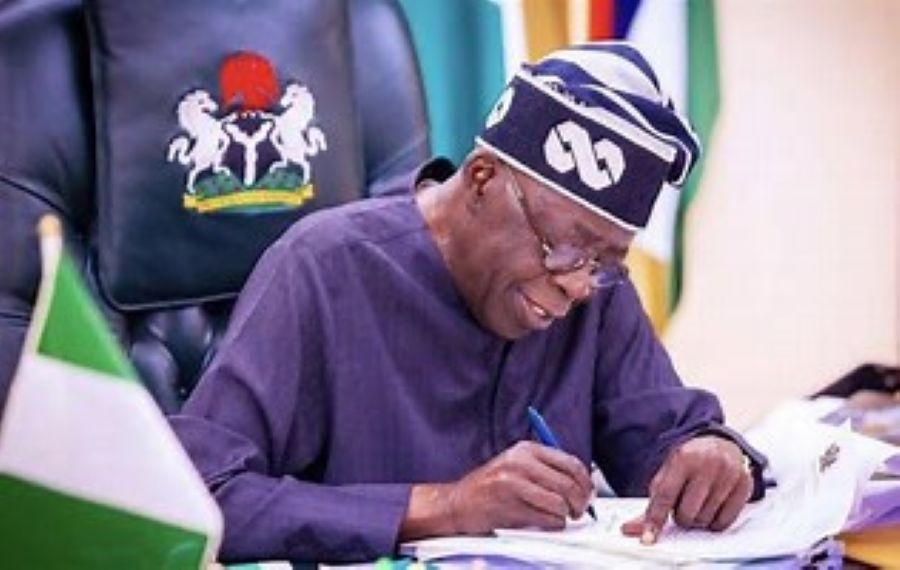
The Nigerian President Bola Tinubu has signed the Electoral Act, 2022 (Repeal and Re-Enactment) Bill, 2026 into law.
The National Assembly had on Tuesday harmonised the bill before sending it to President Tinubu for his signature.
Contentious Bill
The Senate’s consideration of the bill was particularly contentious. Disputes centered on Clause 60(3), which mandates the transmission of polling unit results. Senator Enyinnaya Abaribe (ADC/Abia South) opposed a proviso allowing manual transmission when electronic systems fail, arguing that reliance on Form EC8A in such cases could undermine electoral credibility.
Senate President Godswill Akpabio initially claimed the division request had been withdrawn, triggering objections from opposition senators. Tensions escalated, leading to heated exchanges and even a brief face-off between Abaribe and Senator Sunday Karimi.
Senate Leader Opeyemi Bamidele, who had moved a motion to rescind the bill’s earlier passage, clarified that Abaribe’s demand for a division vote was in order. In the end, 55 senators supported retaining the proviso for manual transmission as a backup, while 15 opposed it.
Main Clauses
The Senate also highlighted technical inconsistencies in the bill, noting issues in clauses 6, 9, 10, 22, 23, 28, 29, 32, 42, 47, 51, 60, 62, 64, 65, 73, 77, 86, 87, 89, 93, and 143, which affected cross-referencing, numbering, and internal coherence. These discrepancies, combined with debates over Clause 60, delayed the bill’s passage and necessitated detailed clause-by-clause consideration.
Meanwhile, the House of Representatives experienced its own disruption. Francis Waive, Chairman of the House Committee on Rules and Business, moved a motion to rescind the December 23, 2025 approval of the bill.
Speaker Tajudeen Abbas declared the motion carried despite protests from several lawmakers, plunging the chamber into chaos. Members later moved into a closed-door session to deliberate further.
The dispute between the chambers primarily revolved around the electronic transmission provision. The House had originally mandated real-time transmission of results from each polling unit to the Independent National Electoral Commission’s Result Viewing Portal (IReV) immediately after Form EC8A is signed and stamped.
The Senate initially rejected this approach, prompting criticism from civil society and election reform advocates. After negotiations, the upper chamber agreed to electronic transmission while allowing manual collation as a backup in case of network failures.
To reconcile differences, a conference committee was formed to harmonise both chambers’ versions. Civil society groups have urged lawmakers to uphold the House’s position, stressing that real-time electronic transmission is key to credible, transparent elections.
2027 election timetable
The debates also addressed the 2027 election timetable. Concerns were raised that strict adherence to the 360-day notice requirement could push elections into the Ramadan period, affecting voter turnout, logistics, and inclusiveness.