IPI Nigeria -website-logo
The International Press Center, IPI Nigeria Chapter has unveiled “Book of Infamy” . The unveiling was done by Vice President Kashim Shettima at the second Annual Conference of IPI Nigeria, held in Abuja, Nigeria’s capital.
The Book of Infamy was a publication which meant to document impunity, harassment and intimidation of Journalists across Nigeria. Against this background, the (IPI) Nigeria has listed the Inspector General of Police, IGP Olukayode Egbetokun and two Governors, Akwa Ibom State, Imo Eno; and Niger State, Mohammed Umar Bago.
Rationale for Inclusion of Names on Book of Infamy
The Inspector General of Police, OluKayode Egbetokun was said to have failed to heed the calls by IPI to stop the arbitrary arrests of Journalists nationwide by his operatives. Governor Eno barred the crew of Channels TV from covering the activities of the Akwa Ibom State Government House. Governor Bago ordered the closure of Badeggi FM, a private radio station.
Despite appeals by IPI Nigeria for reconsideration of their decisions which they had no powers to so take, both Bago and Eno refused to back down.
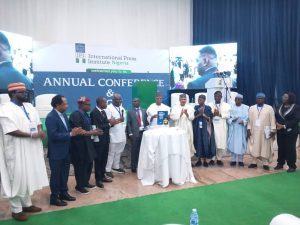
Honour For Director of State Security Services
The Director General of the Department of State Services (DSS), Adeola Oluwatosin Ajayi was honoured by the IPI Nigeria for his quite achievements and as a listening head of a sensitive government agency credited with the quick release of Journalists who were wrongly arrested by the secret police through interventions by the IPI. The DSS Boss also corrected wrongdoings pointed out to him through removal from the government’s watchlist of the Executive Director of the International Press Centre, Lanre Arogundade, after 40 years
Endowing a prize For Late Journalist at the University of Abuja
Nigerian National Committee of IPI Nigeria has also concluded arrangement to endow a prize in honour of a Journalists, Late Rafat Salam, of Voice of Nigeria and Treasurer of IPI Nigeria, at the University of Abuja, her alma mater. According to the President of IPI Nigeria, Musiliku Mojeed,
” IPI will work with the university to ensure that every year, young journalists are inspired by the values Rafat lived by—integrity, courage, and selfless service. Rafat Salami, Last year, even in severe pain and confined to a wheelchair, she insisted on attending the conference. She greeted guests, coordinated logistics, took photographs with her phone, and served with grace until her body could no longer carry her. Her commitment was a reminder that journalism is not merely a job; it is a calling. It demands sacrifice. It demands conviction”
The Nigerian Media Landscape In Distress
Musikilu Mojeed regretted that the Nigerian media landscape is in distress, as the country fell ten places—from 112 to 122—in the global Press Freedom Ranking.
He said that steep drop is not the result of one incident, it was the cumulative effect of consistent and aggressive repression across states, across platforms, and across newsrooms.
Nigeria is classified as one of West Africa’s most dangerous and difficult countries for journalists.
The leader of IPI in Nigeria noted that the current negative development was not a beautiful portrayal of the country, as Journalists are monitored, attacked, and arbitrarily arrested, while lawfully reporting activities (filming a demolition, covering a protest, documenting police misconduct) have become dangerous acts.
Statistics of Impunity and Harassment
According to available statistics four media organisations shut down for political reasons in Zamfara, namely (NTA, Pride FM, Gamji TV, and Al-Umma TV) closed simply for airing an opposition rally.
Investigative journalist, Segun Olatunji, was abducted, blindfolded, chained, in Lagos and transported hundreds of kilometres away from his base for a controversial reporting.
In August 2024 alone, at least fifty-six (56) journalists were assaulted or arrested while covering demonstrations across the country.
Online reporters are now frequent victims of cybercrime accusations of the cybercrime law, despite recent amendments, continues to be used to suppress digital journalism. Several journalists have been arrested or prosecuted under this legislation.
Journalists Must Stand United
Mr Musikilu Mojeed admonished Nigerian journalists to stand united in the face of intimidations and oppression. In his words,
” To our colleagues across the country: This is not the time for apathy and isolation. We must act as a unified community. When a journalist is arrested in Kano, colleagues in Akwa Ibom must care. When a newsroom is attacked in Niger State, reporters in Lagos must speak out. When a reporter disappears in Lagos, editors in Abuja must raise the alarm. Solidarity is our greatest line of defence. The stakes are high. Independent journalism is the lifeblood of democracy. When the press is intimidated, elections lose credibility, governance becomes opaque, corruption flourishes, and citizens lose their voice. We must not allow that to become Nigeria’s story”.
Appeal To the Nigerian Government
He urged the Federal Government to call state governors, security agencies, other officials involved in impunity against media and journalists to order.
” The government should ensure state governors, security agencies, and public officials stop the harassment of journalists: No democracy can function when those who hold power to account are shielded from scrutiny. This administration should also strengthen mechanisms for journalist safety: Nigeria has no functioning state protection system for journalists. This must change. In addition, the time has come for Nigeria to review laws that enable abuse, particularly the cybercrime and outdated criminal defamation provisions. He stated
Nigeria Vice President Opens IPI Nigeria Annual Conference
Investigative Journalism Facing Threats In Africa
About the Author