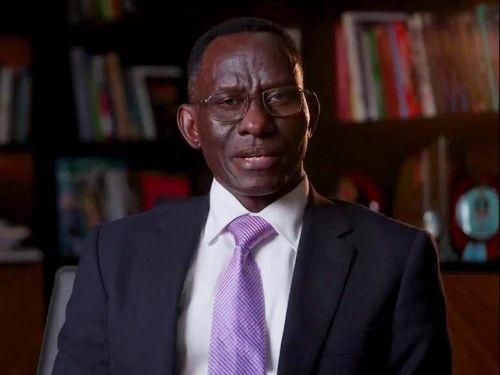
General Lucky-Irabor Rtd

GEN LUCKY E.O. IRABOR (RTD) CFR
PUBLIC PRESENTATION at a book launch “OTOGE: THE LEGACIES OF POLITICAL LEADERSHIP IN NIGERIA”
Introduction
I am deeply honoured to be here at today’s public presentation of the book: “OTOGE:
The Legacies of Political Leadership in Nigeria.” The topic I was given is “Nigeria’s Security: A Collective Responsibility.” No doubt, security is a subject that is so mfundamental to the future of our country, given that it is the foundation upon which every other national aspiration rests.
Being at the cusp of another election season, Security is an appropriate subject to discuss at the presentation of a book that reflects on political leadership and the lessons of our recent electoral history.
Let me therefore, begin with a fundamental truth: there can be no meaningful political leadership, economic development or democratic progress in an insecure society. When citizens are afraid to travel, then businesses cannot operate confidently.
When farmers do not go to their farms, food security becomes a mirage. When communities do not trust security institutions, intelligence dries up and citizens begin to believe that government cannot protect them.
Consequently, the social contract with the State weakens and ultimately fractures. From the foregoing, it is clear that though security is fundamental to the proper functioning of the society, it is not necessarily only about the hard power effect represented by the Armed Forces, Police, DSS, intelligence community or other security agencies. Security is about the inputs of every one of us and how we are governed. In effect, it is the aggregation of the hard and soft power elements, smartly synchronized in governance processes that guarantees security for all.
Without a doubt, Security is the first duty of the state. Yet the deeper truth is that: no security architecture, however well-resourced or professionally led, can succeed if the larger society treats security as the exclusive business of men and women in uniform. Security is a shared enterprise – a social contract in which every citizen, institution and tier of government has a non-negotiable stake. I therefore concur with the topic that Nigeria’s Security is a collective responsibility.
WHY COLLECTIVE RESPONSIBILITY IS IMPORTANT
Understanding Nigeria’s Security as a collective responsibility is important because in the first instance, the scale of our current challenge exceeds the capacity of the formal security sector to handle alone. Without rehashing details of Nigeria’s complex, and multi dimensional security challenges, it is clear that our population, geography, and the sophistication of modern criminal networks demand more eyes, more information, and more local ownership than any force can provide. Community vigilance, early warning, and the denial of sanctuary to criminals are force multipliers that no amount of equipment or sophisticated security personnel can replace.
Another important factor is that insecurity is often a symptom of deeper challenges like poverty, youth unemployment, weak local governance, and the erosion of social cohesion. Kinetic operations can suppress violence and create space for good governance to take root, but they cannot, by themselves, resolve the conditions and root causes of the insecurity.
Development, justice, education, and inclusive politics are therefore security tools, and these tools are usually not in the hands of the uniformed personnel. The proper administration of the relevant policies will convert a young person into a stakeholder in the future of his community. The young people then become guardians of that future rather than recruits for those who seek to destroy it.
Furthermore, democratic legitimacy itself depends on the perception that the state protects all citizens equally. When communities are left without state presence, non-state actors step in to fill the void, and this fractures the social contract upon which citizens delegate democratic authority to the State. Collective responsibility, therefore, means that political leaders, traditional institutions, religious organisations, the media, the private sector, and ordinary citizens all accept that the safety of one is the safety of all.
THE ROLE OF POLITICAL LEADERSHIP
In line with the central theme of the book we celebrate today, that is, the legacies of political leadership in Nigeria, it is certain that political leadership shapes the environment in which security either flourishes or fails. Under the current global and generational social regime, it must be understood that leadership that prioritises national cohesion, invests in institutions and communicates honestly with the people, strengthens the foundation of security. It is therefore important that our political leaders do not treat security as a partisan instrument. Rather, they should equip security professionals to function optimally.
Additionally, the politicians must also commit to the long-term work of building capable institutions that hold the security institutions accountable.
President Bola Ahmed Tinubu’s public-service journey, as chronicled in this book, offers lessons in persistence, coalition-building, and the understanding that power is a trust. The late Senator Ifeanyi Ubah’s legislative work and his contributions to Nigerian sports remind us that leadership is also about leaving tangible legacies that outlive the individual. Both leaders underscore a simple truth: the quality of political leadership determines, in large measure, the quality of the security environment we bequeath to the next generation.
As we look toward the 2027 elections, we should insist that security remains a national concern and not a partisan subject. The integrity of the electoral process, the safety of voters and officials, and the acceptance of legitimate outcomes are all security issues. A peaceful election is itself a victory for collective responsibility.
https://www.instagram.com/reels/DewXjgkoUUE/
PRACTICAL PATHWAYS TO COLLECTIVE RESPONSIBILITY
In practical terms, what does collective responsibility look? Collective responsibility means that not just the federal government but also the sub-national governments should treat security as a core governance function, not an afterthought. In this regard, the practical manifestations of collective responsibility include: a. Rule of Law as the Pillar of Collective Responsibility. The rule of law is the fundamental and indispensable pillar of national security. Rule of law creates the institutional framework that enhances security and allows collective responsibility to thrive. When laws are applied equitably, justice is delivered transparently, and human
rights are rigorously protected, state institutions build the public trust required for active citizen collaboration. It must be noted that Security cannot rely solely on enforcement. Rather, it needs a shared commitment to legal order where no individual or institution operates above the law, and where every citizen and organization actively upholds the integrity of our legal institutions and frameworks in order to preserve national peace and stability.
b. Vigilance and community ownership by the Citizenry. The most potent intelligence network in the world is an active, vigilant, and patriotic citizenry. Communities know who lives among them and when strange patterns emerge. The principle of “See Something, Say Something” must move from a public slogan to an embedded cultural norm. Citizen participation also means refusing to offer safe havens, logistics, or intelligence to criminal elements operating within local communities.
c. Correct use of moral authority by traditional, religious, and community Institutions. Traditional rulers and religious leaders are the custodians of communal values and the primary arbiters of local conflict. They possess moral authority that no official policy can replicate. Their responsibility lies in early-warning conflict resolution, countering extremist ideologies, fostering inter-communal dialogue, and guiding the youth away from crime and violence.
d. Objective journalism by the media, influencers and public communicators. As journalists like Edwin Akwueh document our national story, the media remains a vital actor in the security architecture. The responsibility of the press is double-barreled: to hold government, security institutions etc accountable while practicing patriotic, objective, and constructive reporting that does not compromise operational security or demoralize the personnel risking their lives for the nation.
e. Private sector investments in security. Security and commerce share a symbiotic relationship. Businesses cannot thrive without security, and security cannot be sustained without a thriving economy. The private sector’s collective responsibility includes investing in corporate security initiatives, supporting technology-driven intelligence frameworks, complying with anti-money laundering regulations, and
creating opportunities for youth employment to reduce economic drivers of crime.
Continuous professionalization by the security forces. For my colleagues in uniform, collective responsibility demands continuous professionalization, adherence to the rule of law, respect for human rights, and deep inter-agency collaboration. The era of inter-agency rivalry must give way to integrated intelligence sharing, joint operational execution, and unwavering commitment to the protection of every Nigerian life and property.
Conclusion
Collective responsibility is very important to the success of our democraticconsolidation. Democratic legitimacy itself depends on the perception that the state protects
all citizens equally. When communities are left without state presence, not only do non-state actors step in to fill the void, it also fractures the social contract upon which citizens delegate democratic authority to the State. Collective responsibility therefore means that political leaders, traditional institutions, religious organisations, the media, the private sector, and ordinary citizens all accept that the safety of one is the safety of all.
Finally, I want to commend Mr. Edwin Akwueh, for publishing this book. Through the book, “OTOGE: The Legacies of Political Leadership in Nigeria”, he has provided us with, not just a record of political events, but an opportunity to reflect on the governance imperatives necessary for our nation’s progress.

I also commend His Excellency, President Asiwaju Bola Ahmed Tinubu, GCFR, for his tremendous efforts to expand and reposition the Armed Forces to meet current and future security challenges. I implore him not to rest on his past achievements until the work is completely done and the life of every citizen within and outside Nigeria is properly secured.
For the rest of us, present here and across the country, whether political, civil or military leaders, I want to remind us that the task of securing Nigeria is a continuous, evolving, and noble endeavour. Let us leave this hall today with a renewed commitment to our shared responsibility. Let the military officer in the field, the police officer at his post, the politician at the council level, the journalist with the pen, the traditional ruler in the
community, and the citizen in the neighborhood, all recognize that the defence, peace, and security of Nigeria collectively rests on all our shoulders. When we accept this collectiv burden, we do not merely confront security challenges, we secure the democratic future and prosperity of the Federal Republic of Nigeria.
Thank you for your attention. God bless you and God bless the Federal Republic of Nigeria.
Read More : https://von.gov.ng/book-examines-political-leadership-and-nigerias-democratic-future/
- Author / Writer: Edwin Akwueh (Nigerian journalist, author, and public affairs commentator.
- Theme: An exploration of political leadership, governance, institutional legacy, and democracy in Nigeria, drawing on the significance of the “Otoge” political movement and historical shifts in leadership.
About the Author